
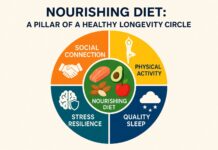









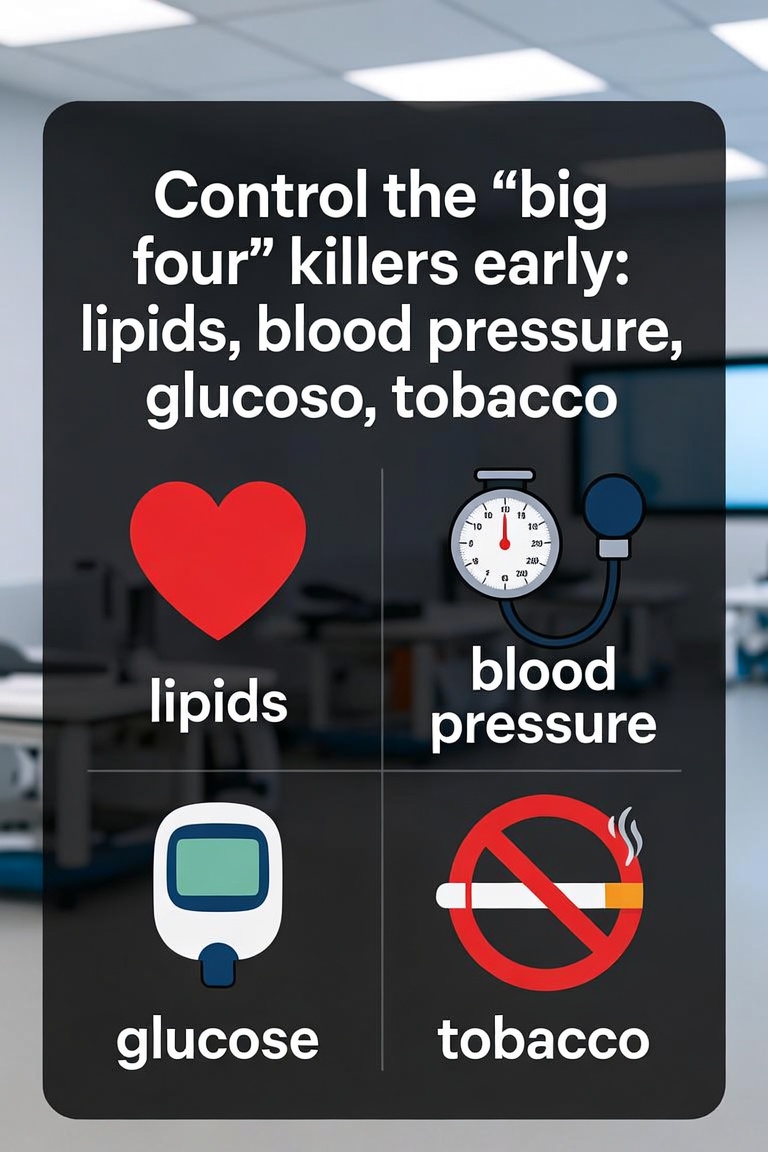
Most years of healthy life are still lost to atherosclerotic disease, cancer, metabolic disease and neurodegeneration. The tools that cut that list are not biohacks. They are mid-20th-century discoveries applied early and without romance: do not smoke, keep atherogenic particles down, keep blood pressure down, keep glucose and visceral fat down.
That is unglamorous. It also outperforms most supplements.
Tobacco. Never start. If you already smoke, quitting is still one of the highest-yield acts in medicine. Smoking accelerates DNA-methylation clocks that track mortality; former smokers sit between current and never smokers, and each year off cigarettes is associated with a further drop in that acceleration. Some smoking-related methylation marks fade over years to decades; others linger. The clinical meaning is simpler than the epigenetics: risk of heart attack, stroke, cancer and death falls after cessation, and it keeps falling. There is no “too late” that cancels the benefit.
Lipids — measure the particles, not only LDL. LDL cholesterol is useful and incomplete. Each atherogenic particle carries one ApoB; ApoB therefore counts the particles that actually enter the artery wall. It is especially informative when triglycerides are high, diabetes is present, or LDL looks “fine” after treatment. Lipoprotein(a) is mostly genetic. Measure it once. The 2026 ACC/AHA dyslipidemia guideline now gives that once-in-a-lifetime Lp(a) test a Class I recommendation. Levels around 125 nmol/L (50 mg/dL) and above are a risk enhancer; very high values can approach the lifetime risk of familial hypercholesterolemia. You cannot diet Lp(a) away. You can treat everything else harder.
The same 2026 guideline moved prevention earlier for a reason: plaque accumulates silently for decades. Risk estimation with the PREVENT equations now starts at age 30 and includes 30-year as well as 10-year risk. Statin therapy can be considered in the 30s when lifetime risk is high, LDL is 160 mg/dL or more, or the family history is bad. Borderline 10-year risk is now 3–5%; intermediate is 5–10%. That is a deliberate shift toward treating exposure time, not waiting for a first event. Coronary calcium scans still help when the decision is uncertain. The point is not to medicate every 32-year-old. It is to stop pretending that a “normal” LDL at 35 means the arteries are empty.
Blood pressure. Midlife hypertension is one of the strongest modifiable risks for later dementia as well as for stroke and heart failure. Intensive lowering in trials — SPRINT-MIND toward a systolic under 120 mm Hg, and a large rural-China program aiming under 130/80 — reduced mild cognitive impairment and, in the China trial, all-cause dementia. Treat early. Treat to a real number, not “a bit high for your age.” Home readings beat a single clinic spike. Late-life targets can be individualized if frailty or falls dominate; midlife is the window you do not waste.
Glucose and visceral fat. Insulin resistance and the fat around the organs are not only a heart problem. They are a brain-protection problem. Keep waist, fasting glucose or HbA1c, and triglycerides in range with the same stack already covered: fitness, sleep, a plant-forward plate, and no surplus. Drugs have a place when lifestyle is not enough. They do not replace the stack.
None of this requires a longevity clinic. It requires a lipid panel that includes ApoB, an Lp(a) once, a blood-pressure cuff you use, an HbA1c, and an honest answer about cigarettes. Do those four before you optimize anything exotic. The decades you buy are the ones plaque has not yet claimed.