
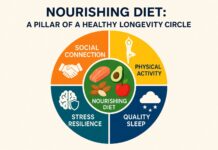










Sleep is not passive downtime. It is an active biological process that clears metabolic waste from the brain, regulates hormones, supports immune function, stabilizes metabolism, and preserves cognitive performance. Adults who consistently obtain roughly 7–8 hours of quality sleep show the most favorable profiles for long-term health, while both short and long durations, or irregular schedules, are linked to higher risks of metabolic disease, cognitive decline, and mortality.
Duration: The U-Shaped Relationship with Health Outcomes
Large meta-analyses of prospective cohorts demonstrate a U- or J-shaped relationship between sleep duration and all-cause mortality. The lowest risk typically centers around 7–8 hours. Short sleep (commonly defined as less than 7 hours) is associated with roughly a 14% higher mortality risk in pooled analyses, while long sleep (9 hours or more) shows even stronger elevations, often in the range of 30% or higher. Similar patterns appear for cardiovascular events and other outcomes. These associations hold after adjustment for many confounders, though residual reverse causation (illness leading to longer sleep) may partly explain the long-sleep side of the curve.
Quality matters alongside quantity. Fragmented or non-restorative sleep, even when total time in bed appears adequate, is linked to higher risks of diabetes, coronary heart disease, and poorer cognitive outcomes. National Sleep Foundation and other guideline ranges generally align with 7–9 hours for most adults, with 7–8 hours often cited as the practical sweet spot for older adults.
Consistency of Schedule: Often as Important as Total Hours
Emerging evidence indicates that regularity of sleep timing can be as predictive of health as total duration. Systematic reviews and large biobank studies link greater variability in sleep onset and wake times to higher risks of depression and anxiety, elevated BMI and insulin resistance, hypertension, cardiovascular events, smaller hippocampal volume, increased dementia risk (on the order of 26–53% in some analyses), and higher all-cause mortality. In several cohorts, sleep irregularity predicted mortality more strongly than sleep duration itself, independent of total hours and quality.
Circadian misalignment from irregular schedules disrupts hormone rhythms, autonomic balance, and inflammatory signaling. National Sleep Foundation consensus statements affirm that consistency of sleep timing supports health and performance. While catch-up sleep on non-work days can partially mitigate short weekday sleep, the strongest outcomes are seen with stable daily schedules.
Core Physiological Benefits
During sleep—especially deep non-REM stages—the glymphatic system becomes highly active. Cerebrospinal fluid flow increases, interstitial space expands, and waste products including amyloid-beta and other metabolites are cleared more efficiently. Animal and human imaging studies show markedly slower clearance when sleep is restricted or fragmented, providing a mechanistic link between poor sleep and elevated risk of neurodegenerative processes.
Sleep also governs hormone regulation. Growth hormone pulses, cortisol rhythms, leptin and ghrelin (appetite hormones), and insulin sensitivity are tightly coupled to sleep architecture. Chronic short or irregular sleep promotes insulin resistance, elevated appetite, and unfavorable shifts in energy balance. Immune function is likewise sleep-dependent: adequate sleep supports adaptive immune responses, while deprivation elevates inflammatory cytokines and impairs vaccine responses and infection defense.
Cognitively, consolidated sleep consolidates memory, supports synaptic homeostasis, and maintains emotional regulation. Long-term poor sleep is associated with accelerated cognitive decline and higher dementia incidence.
Practical Implications for Healthspan
Aim for a consistent 7–8 hour window of high-quality sleep, anchored to a regular bedtime and wake time (including weekends when feasible). Prioritize dark, cool, quiet environments; limit late caffeine, alcohol, and bright screens; and address treatable conditions such as sleep apnea, which fragments sleep and independently raises cardiovascular and metabolic risk. Daytime light exposure, regular physical activity, and stable meal timing reinforce circadian alignment and improve sleep quality.
Individual needs vary with age, genetics, and health status, and some people function well slightly outside the 7–8 hour range. Persistent difficulty falling or staying asleep, or daytime impairment despite adequate opportunity, warrants clinical evaluation.
The Bottom Line
Consistent quality sleep of roughly 7–8 hours is one of the highest-leverage, lowest-cost interventions for metabolic health, cognitive resilience, immune function, and longevity. It enables nightly brain waste clearance, stabilizes hormonal and metabolic rhythms, and reduces risks of chronic disease. Combined with physical activity, nutrition, and other lifestyle foundations, stable sleep forms a non-negotiable pillar of healthspan.